
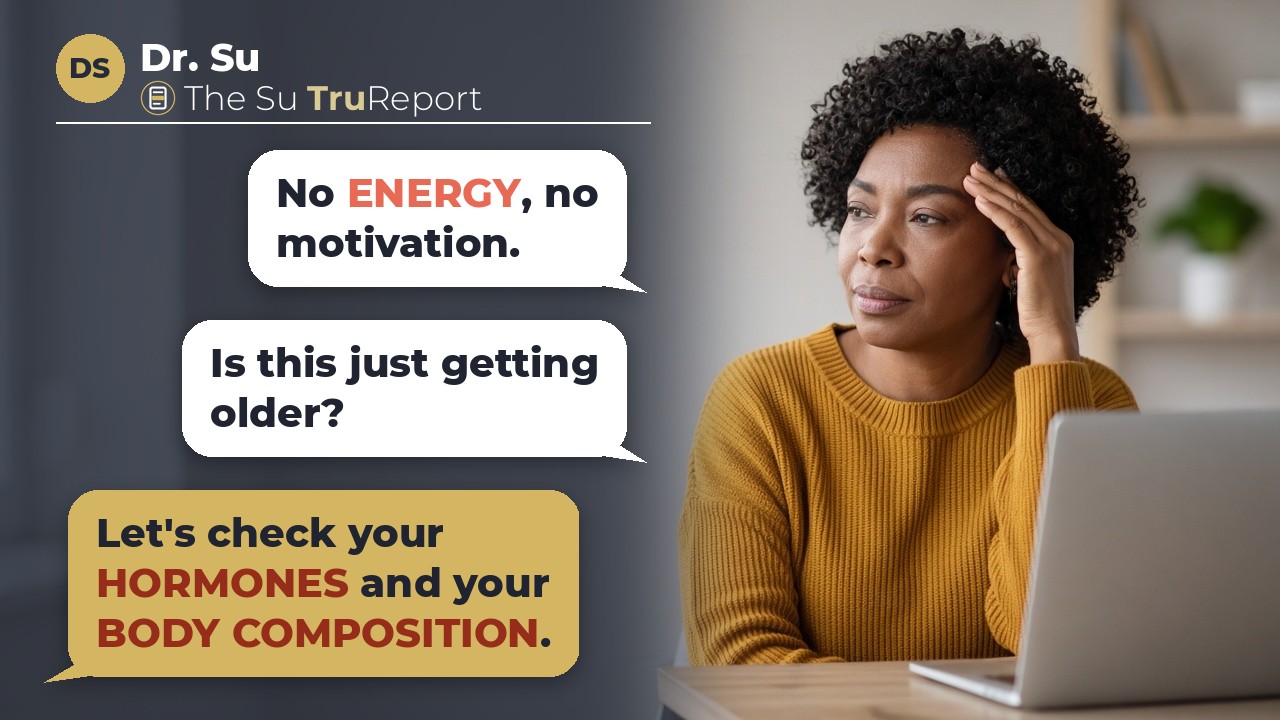
Ever walk right past your own home gym, again, and wonder where your energy went? Maybe you've gained a few pounds, your motivation is gone, and everyone tells you it's "just getting older."
In this episode of the Functional Medicine Reality Podcast, TruWellness Medical Director Dr. Mark Su talks with a longtime patient in her late 50s who decided that answer wasn't good enough. (She asked to stay anonymous, so we won't use a name.) Her story covers body composition, exercise, mindset, ADHD and hormone therapy, and how they worked together.
Listen to the full episode
Episode 38 – A Patient's Story on Hormones, ADHD, and Getting Her Life Back
The scan that changed her mind
At her physical last October, she told Dr. Su she'd gained about 15 pounds and wanted to do something about it. He suggested a body composition scan as a baseline. She didn't hesitate. She likes data, and she'd have "run upstairs" to do it that day.
The results surprised her. She works in IT and lifts heavy servers, so she thought of herself as strong. But the scan showed less muscle and more fat than she expected, including the fat around the middle that matters most.
Dr. Su explains why a scan tells you more than a bathroom scale:
We can't measure that well externally. And your BMI doesn't really reflect that at all.
Dr. Mark Su, MD · Medical Director
Her muscle mass was at the 55th percentile for her age, which he calls very reasonable. He also explains how he sets goals:
We always say, hey, our first goal is 50%.
Dr. Mark Su, MD · Medical Director
From there, the next goals are 75% and then 90%. Her body fat was about 41 to 42%, where he says "normal" is about 35% and under. To aim higher, they compared her numbers with a 35-year-old's.
From walking past the gym to joining one
Then the holidays happened. By January her energy was "terrible," and she could feel it affecting her focus and mood. She had a well-stocked gym at home that she just walked past.
So she made a plan: join a gym and book classes, for the accountability and the community. Dr. Su suggested a few local options, and she joined in February. He notes that many people hesitate to get tested because then they have to act on it, and there's a bigger point:
I think there's a lot of tools that people don't know that they can take action on.
Dr. Mark Su, MD · Medical Director
The hormone piece
Her lab panel showed she had very little of several key hormones. They started hormone therapy as a trial and adjusted it based on how she felt and on follow-up data. And yes, testosterone was part of it. As she says, women use testosterone too.
How much did hormones matter? She's clear: she doesn't think she could have kept going to the gym without them, because her energy had been "down in the basement."
ADHD, hormones and "standing up before I finish the thought"
She has managed ADHD with medication for about two years, after an earlier medication didn't suit her sleep. With treatment, she says, she can choose what to focus on instead of having "five different songs" playing in her head.
Adding hormone therapy made a noticeable difference on top of that. She describes it as the gap between wanting a result and having no energy to start, versus standing up and taking action before she's even finished the thought.
Why the combination matters
Dr. Su says many of his more holistic colleagues are wary of ADHD medication. He agrees that structure, routine, nutrition, fitness and sleep matter. But some people do all of that and it still isn't enough, and some people take the medication and still fall short.
And so the combination is always best
Dr. Mark Su, MD · Medical Director
She had tried supplements and a strict, vegetable-heavy diet for years and still couldn't "get my brain going." Her advice to others: do everything you can for yourself, and take what you need to be okay.
So a lot of times there's a sequence that matters.
Dr. Mark Su, MD · Medical Director
Just keep going
Her vitality score went from about a three last fall to a solid eight, sometimes a nine, in about five months. She credits exercise, a mindset shift ("I'm 57. I have plenty of years to do whatever I want"), better sleep, ADHD care and hormones. When people tell her it's "just getting old," her answer is: "No, you can keep that."
Her advice: walk half an hour a day for a couple of weeks, then pick up something heavy. If week four doesn't feel different yet, keep going anyway. And lean on your people. Her motto: "Live while you're alive." Individual results may vary.
From TruWellness
How TruWellness can help
If low energy, weight gain or "just getting older" sounds familiar, our clinical team, under the direction of Dr. Mark Su, MD, FAAFP, can help you find your starting point in Newburyport:
- TruVitality hormone therapy: HRT for women and TRT for men, based on your labs
- Body composition scan to see your muscle and fat as a baseline
- VO2 max and RMR testing to track your fitness
- Functional medicine for the bigger picture
What to expect
- A real conversation about your energy, goals and what you've already tried, plus labs as needed.
- A plan built around you, adjusted as you go based on how you feel and your follow-up data.
Patients come to our Newburyport office from Amesbury, Newbury, Salisbury, Haverhill and across the North Shore and the Merrimack Valley.
Book a ConsultationThis article is for education only and isn't medical advice. Talk with a licensed provider about what's right for you. Individual results may vary.