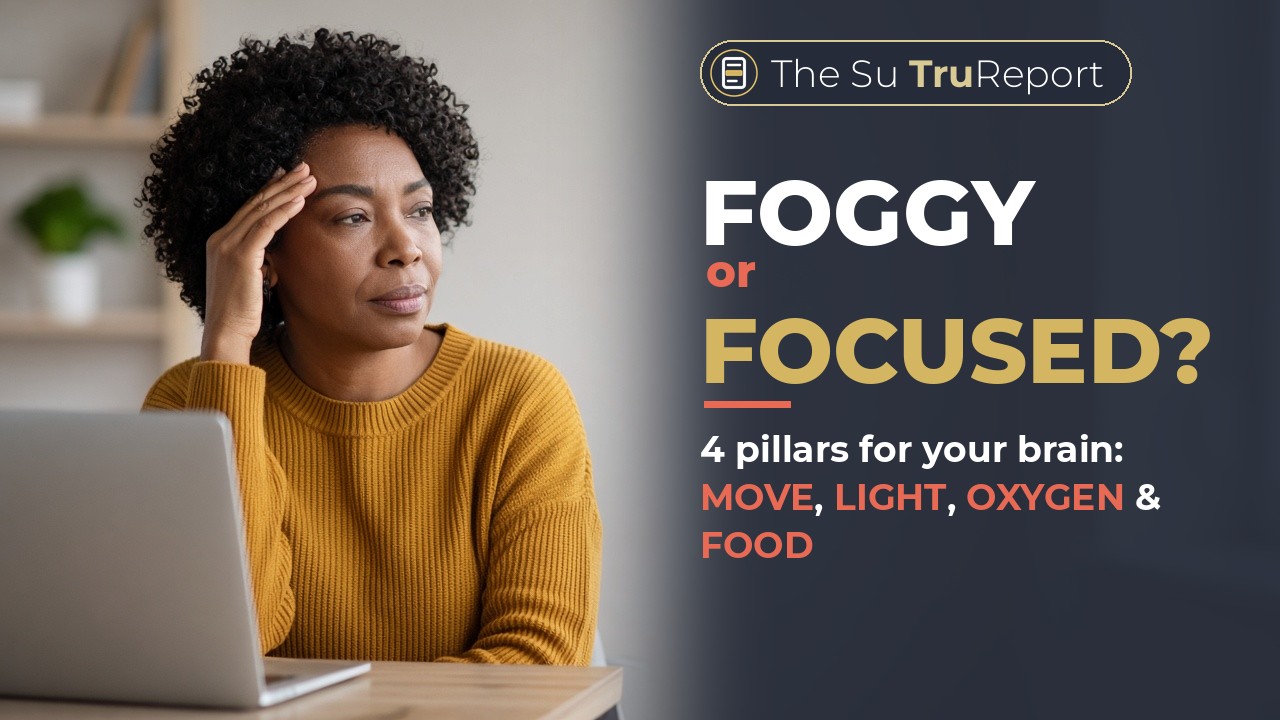
Most of us see the dentist once or twice a year and brush and floss every day. But how many of us ever get a brain checkup?
On this episode of the Functional Medicine Reality Podcast, TruWellness Medical Director Dr. Mark Su sat down with Dr. Trevor Berry, a board-certified chiropractic neurologist who specializes in brain health. Dr. Berry is an expert in low-level laser therapy, hyperbaric oxygen therapy and neurofeedback, and co-founder of Brain Restore Centers. Together they walked through the foundations of a healthier brain. Here are the main takeaways, in plain English.
Listen to the full episode
Episode 40 – The Brain Health Playbook with Dr. Trevor Berry
Why your brain needs a checkup
Dr. Berry says brain health is an underserved area of healthcare. Too often, people only get checked once they start having cognitive decline in their 70s.
We'll go to a dentist once or twice a year and brush and floss every day and things like that. We're not doing that at all with brain health.
Dr. Trevor Berry · Board-certified chiropractic neurologist
His view is simple: the best way to treat Alzheimer's is to do things right now to prevent it.
How Dr. Su got here
Dr. Su admits he started as a skeptic. A nurse practitioner in his office pushed for years to get a low-level laser, which he describes as a roughly $15,000 investment. After meeting Dr. Berry at a conference, Dr. Su spent a few days at his Arizona clinic. "My jaw dropped," he says of what he saw there.
Pillar 1: Move
When Dr. Berry asks research-based AI tools for the top ways to protect and repair the brain, exercise comes up first. His big take-home point:
As long as you're living and breathing, you have the opportunity to change your brain. You're not stuck with the brain that you have today.
Dr. Trevor Berry · Board-certified chiropractic neurologist
This is neuroplasticity: what goes into the brain shapes what comes back out, just like building pathways when you learn to ride a bike.
- HIIT: high intensity interval training, like one minute on and one minute off for three minutes, is "huge" for brain growth factors.
- Resistance training: lean muscle mass is critical for brain maintenance. A bicep curl releases growth factors such as BDNF that travel to the brain.
- Complex movement: dance, yoga and tai chi are good for brain pathways and stress reduction.
- Just get moving: a walk after dinner, or a morning walk in the sunlight to set your daily rhythm.
For a lot of people, Dr. Berry says, the simple act of moving is half the battle.
Pillar 2: Low-level laser and red light
Number two on the list is transcranial low-level laser therapy and photobiomodulation. Red is the most commonly used color, and Dr. Berry says there's growing evidence for violet and green as well.
Photobio-modulation is just a fancy way of saying light, modulating your biology.
Dr. Trevor Berry · Board-certified chiropractic neurologist
Two ways light may help the brain
- Calming inflammation: Dr. Berry calls brain inflammation a fire that needs a fire hose. A genetic risk doesn't mean a condition has to show up, and he says inflammation is the number one thing that pushes people "off that cliff."
- Supporting mitochondria: he calls the mitochondria "the conductor of the symphony of the cell," and says lasers are one of the best ways to support their output.
He says light on the brain has been shown to promote the growth of new neurons and new mitochondria. It's the one tool he wouldn't give up:
The one thing you won't take away from me is my laser. That is my number one tool.
Dr. Trevor Berry · Board-certified chiropractic neurologist
On safety, he says low-level devices are very safe, while making clear he isn't telling anyone to shine a laser in their eyes.
Pillar 3: Oxygen and hyperbaric therapy
Number three is oxygen therapies. Dr. Berry notes the brain uses over 30% of the body's oxygen, so getting good oxygen to it is paramount.
- Hyperbaric oxygen therapy: "arguably your best delivery method," he says, because you can be anemic and still get oxygen to the body.
- Other options: high and low altitude training and oxygen concentrators.
- Breathing you can do today: in through the nose for four, hold for four, out through the mouth for eight.
Dr. Berry notes that Dr. Su has hyperbaric too, and that he's seen Dr. Su's hyperbaric photos on social media.
Pillar 4: Diet and nutrition
Many people expect supplements and diet to top the list. Dr. Berry says they matter, but the evidence puts them fourth.
Supplements with the most evidence
- Omega-3 fatty acids, such as fish oil
- B vitamins in a good multivitamin
- Magnesium, which he calls very underserved
The best diet for the brain
In one sense, he says, the best diet is the one the patient will actually stick with. If pinned down, he says the brain works best on ketosis, and fasting or caloric restriction can help. He wouldn't put a late-stage Alzheimer's or Parkinson's patient on fasting, though.
His simple test: would your great-great-grandparents recognize what you're eating? Eat what Mother Nature put on the planet, and skip aspartame, ultra-processed foods and excess sugar.
How brain health is measured
Dr. Su highlights that this approach relies on objective data, not just how someone feels. Dr. Berry describes several tools:
- MoCA (Montreal Cognitive Assessment): a standardized cognitive test scored out of 30 that takes about 10 minutes.
- Omega-3 to omega-6 testing: a red blood cell test of good fats versus bad fats.
- Balance testing: force plate assessment is a sensitive marker of brain health, and falls are the number one cause of preventable death in the elderly.
- QEEG and neurofeedback: mapping which brain areas are overactive or underactive.
Stacking the pillars
Each pillar can be effective on its own, but Dr. Berry says putting them together creates a synergistic effect. He says he hates hearing patients told "there's nothing we could find, and you just got to live with it," because there has to be something causing the brain fog, the fatigue or the dizziness.
If you're a one-trick pony, that makes brain health a lot harder.
Dr. Trevor Berry · Board-certified chiropractic neurologist
Dr. Su agrees the science is real:
This isn't just trendy hearsay or whatnot. There is science behind a lot of this stuff.
Dr. Mark Su, MD · Medical Director
Stress: the brain's hidden enemy
Dr. Berry says chronic stress is one of the biggest predictors of whether the brain goes downhill. It affects sleep and can wipe out neurons in the hippocampus, the brain's memory center.
- Short-term stress is good: a hard interval or a cold plunge makes the brain adapt.
- Meditation: research shows it can help build new gray matter. Dr. Berry meditates almost every day under his laser, stacking modalities.
- Remove chronic stressors: no doctor can fix a bad job or an abusive relationship. Sometimes the change has to be in your life.
Prevention starts now
Dr. Berry says changes linked to Alzheimer's can be happening 20 to 30 years before memory problems appear. That's why he says we need to "floss our brain every day": move, eat reasonably well, and get better sleep.
Dr. Su points out that prevention isn't a popular word, but it has a new name:
The sexier term these days is like anti-aging and longevity, which is kind of like synonymous with prevention in my book.
Dr. Mark Su, MD · Medical Director
Why change is hard, and how it sticks
- There's no pill for it: Dr. Berry says no single pill covers everything the brain needs.
- Quick wins build momentum: when brain fog lifts, people feel hope and get motivated to do more.
- Give it time: Dr. Berry builds on at least three months, and says it takes at least a month of reinforcement to build new pathways, like a new golf swing.
- Identity matters: Dr. Su says "a bigger sustaining factor in behavior change is identity."
Time's ticking, right? The more, the longer we wait, like, well, you're fighting uphill battle.
Dr. Mark Su, MD · Medical Director
From TruWellness
Hyperbaric oxygen and red light therapy in Newburyport
Two of the tools discussed in this episode are available at our Newburyport office:
- Hyperbaric oxygen therapy (HBOT)
- Red light therapy, including as a relaxing finish to our facials
What to expect
- A real conversation about your goals and what you've already tried.
- A plan built around you, using the services that fit your goals.
Patients come to our Newburyport office from Amesbury, Newbury, Salisbury, Haverhill and across the North Shore and the Merrimack Valley.
Book a ConsultationThis article is for education only and isn't medical advice. Talk with a licensed provider about what's right for you.