
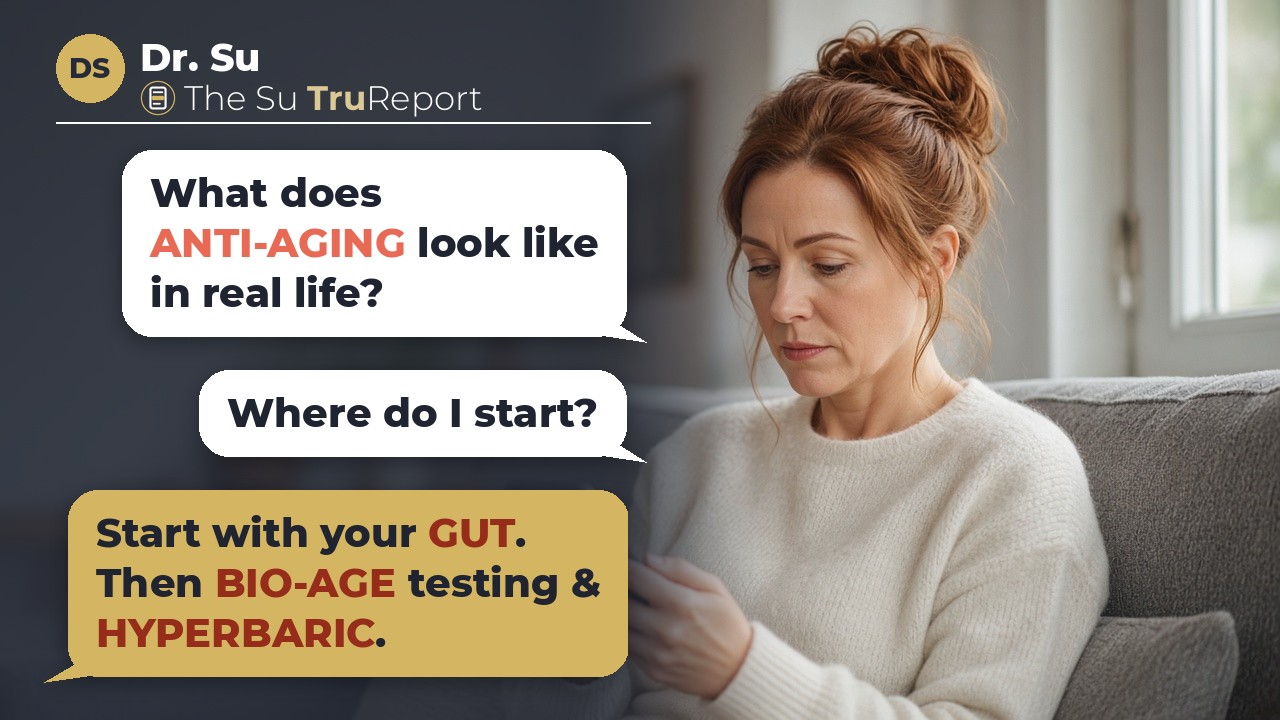
What does "anti-aging" actually mean for you? More energy for a hike? A sharper memory? Not falling on the ice this winter? If your honest answer is "I just want to be healthy," you're in good company.
In this episode of the Functional Medicine Reality Podcast, TruWellness Medical Director Dr. Mark Su sits down with a longtime patient in her 70s who has worked through years of gut trouble. Her goal: keep her energy, her balance and her mind. Here's what they covered, in plain English.
Listen to the full episode
Episode 5 – From GI Struggles to Stability: Anti-Aging in Real Life
The gut years: patience, testing and a journal
Digestive issues kept the patient "busy wondering for years." Over 16-plus years, they worked through:
- Testing: functional stool testing three or four times over the years, and a SIBO breath test.
- Enzymes: low digestive enzymes, which enzymes helped with.
- The gut ecosystem: probiotics, and work on too much bacteria, too much fungus and parasites.
- Food intolerances: sorted out with testing, journaling and trial and error.
- A hiatal hernia that, in her case, needed surgery, which he calls rare in his practice.
He points out that even functional tests aren't always 100% accurate, so tracking how you feel still matters.
Her tip for anyone in the same boat: write it down. Dr. Su agrees, and adds a thought on timing:
Life transitions often are a golden opportunity that make us hit the pause button
Dr. Mark Su, MD · Medical Director
Journaling, he says, gets things out of your head so you can sort them out.
Step 1: Get clear on what you want
Before talking treatments, Dr. Su asks every patient the same question: what does anti-aging or longevity mean to you?
Everybody says I want to be healthy.
Dr. Mark Su, MD · Medical Director
For one person, it means getting on testosterone. For another, it means not falling. For this patient, it means energy, being steady on her feet in the woods, staying sharp and creative, and staying connected to nature and people. As Dr. Su puts it, you have to start with what do you really want.
He also points to data behind socializing, avoiding loneliness and lifelong learning.
Step 2: Know the four age-related disease categories
Dr. Su frames longevity around four age-related disease categories:
- Vascular disease: heart health, and stroke too.
- Metabolic issues: blood sugar and diabetes.
- Cancer.
- Brain health: dementia, Parkinson's and Alzheimer's.
Age changes the plan. In your 40s and 50s, there's more chance to catch problems early. In your 70s, a finding like a positive coronary calcium CT score, which this patient has, "doesn't need to be doomsday," he says. The plan should fit the person: what you tolerate, your age and what you care about.
Step 3: Decide how aggressive you want to be
Next, Dr. Su asks how far you want to go. Many people assume it's all costly.
A lot of it is out of pocket. But it doesn't have to be expensive.
Dr. Mark Su, MD · Medical Director
The options he walks through include:
- IV therapy, including NAD+, which he says has strong rationale and data support.
- Hyperbaric oxygen therapy, with "lots and lots of data," he says.
- Prescriptions, including a statin that new data suggests may reverse biologic clock markers; Dr. Su says he's neutral on it.
- Supplements and hormones, such as anti-inflammatories, brain-health supplements and adrenal hormones like pregnenolone and DHEA.
- Self-care: diet, sleep, movement and socializing.
What the data favors right now
Dr. Su shares what Ryan Smith of TruDiagnostic® told him about the data on longevity: rapamycin, a prescription medication, ranked first, and nutrition second. If you had to pick one eating style, it would be the Mediterranean diet.
We're talking about reversing biologic age.
Dr. Mark Su, MD · Medical Director
That may not change how you feel day to day, he says, but "we know we're doing something positive."
Why hyperbaric oxygen is climbing the list
When it comes to hyperbaric oxygen chambers, Dr. Su says they're fast climbing the ranks:
Really fast climbing the ranks.
Dr. Mark Su, MD · Medical Director
He points to a landmark paper on stabilizing telomeres, the caps at the end of our DNA, and says there's more and more data beyond telomeres now. He also shares that Dr. Trevor Berry, whom he recently shadowed in Arizona, ranks the top three for brain health as exercise, low-level laser therapy and hyperbaric oxygen.
When the patient asks whether this is the treatment for deep-sea divers, Dr. Su explains that by FDA approval, it's for wound care and air pressure disorders from scuba diving. For her, his advice was simple: if there's a clinic near you and the cost works, he'd give it a "total thumbs up." If not, "don't sweat it."
The habits that matter most
Dr. Su's advice on exercise: keep a steady routine, even when it's cold and icy. He also affirms what's hard to measure but still matters:
- Gratitude
- Meditation
- Nature
- People
Because no one can do it all.
Dr. Mark Su, MD · Medical Director
The bottom line for this patient? She's already doing a lot. If she decides she doesn't want to add more right now, he's fully supportive. And if she does, the plan gets customized to her life, because there's always options.
From TruWellness
How TruWellness can help
Several of the options from this episode are available at our Newburyport office, with care from our clinical team, under the direction of Dr. Mark Su, MD, FAAFP:
- Hyperbaric oxygen therapy, right here on the North Shore
- NAD+, as a thrIVe IV or an injection
- Biological age testing, part of our AgeWell longevity program
- Functional medicine, including gut health testing
- TruVitality hormone therapy: TRT for men and HRT for women
- Peptide therapy and VO2 max testing
What to expect
- A real conversation about what anti-aging means to you and what you've already tried.
- A plan built around you, as aggressive or as simple as you want it to be.
Patients come to our Newburyport office from Amesbury, Newbury, Salisbury, Haverhill and across the North Shore and the Merrimack Valley.
Book a ConsultationThis article is for education only and isn't medical advice. Talk with a licensed provider about what's right for you. Individual results may vary.